By the training team at ITECH Vocational Charity (IVC), Ilesa, Osun State
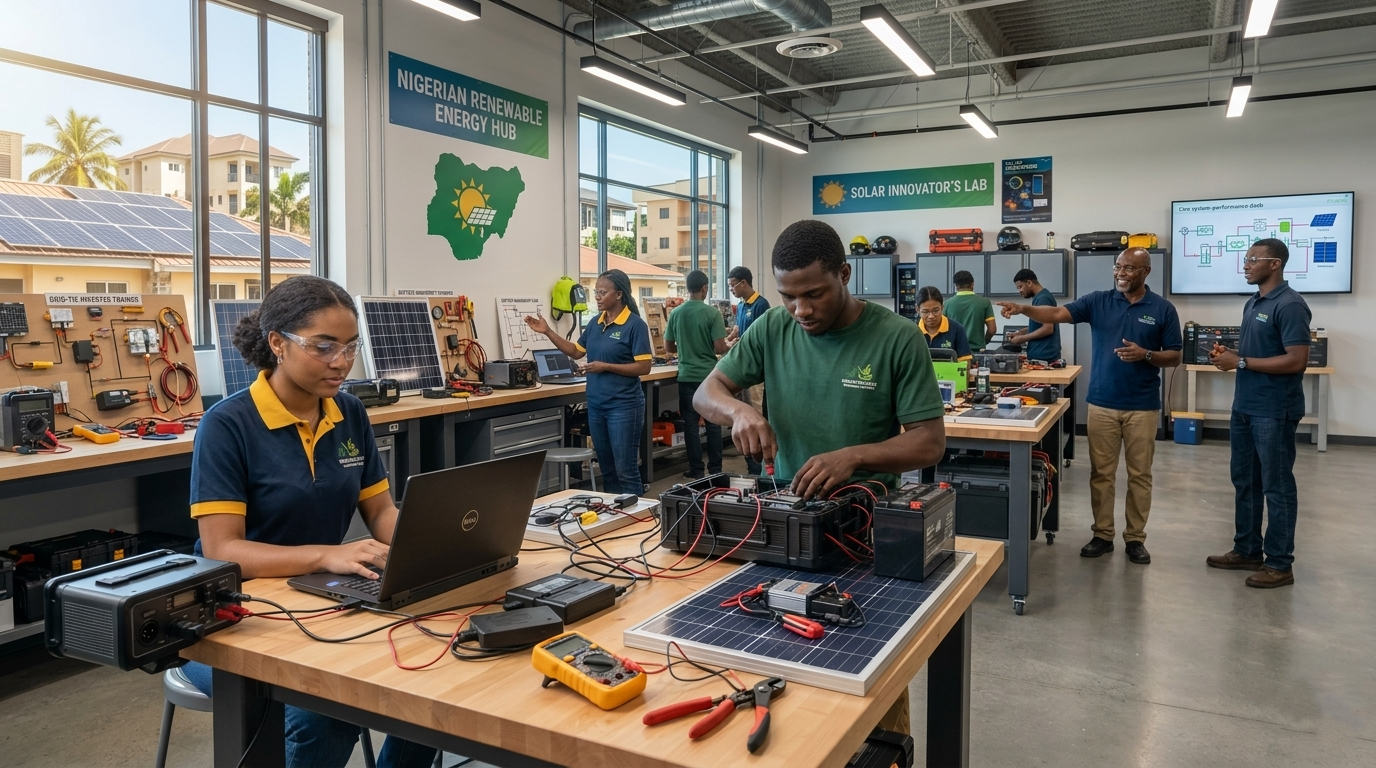
Walk through any of the phone and laptop repair clusters in Ilesa, Osogbo or Akure on a weekday afternoon and you will notice two things.
The first is how much work is sitting on those benches. Cracked displays, dead charging ports, laptops that boot once and never again, inverter batteries that were “just serviced last month” and have already failed. The second is how few of the people behind those benches can actually fix any of it at component level. Most of what passes for repair in Nigeria today is board swapping and part replacement. When the fault is a shorted capacitor, a failed power management IC or a battery cell that drifted out of balance, the device gets declared dead and the customer buys a new one.
That gap between the volume of broken hardware and the number of people who can genuinely repair it is the reason we built the TECH Solar Geeks Program. This article explains the market behind it, the technical content we teach, what the work actually pays, and what the program does not promise. If you are weighing up whether hardware repair and off grid solar are worth six months of your life, we would rather give you the honest picture than a sales pitch.
First, a note about the numbers everyone quotes
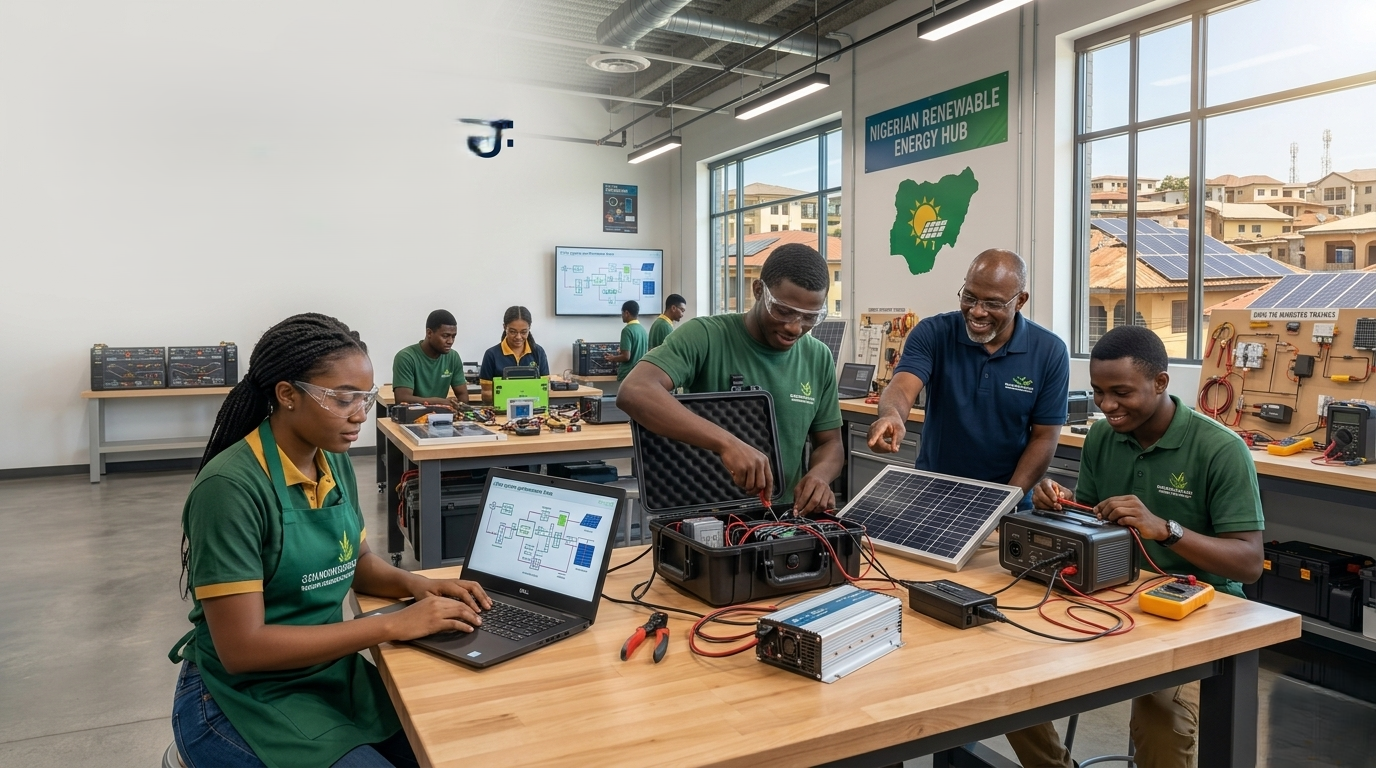
A lot of Nigerian skills content still recycles a youth unemployment figure of 33 percent or higher. Those numbers come from the old National Bureau of Statistics methodology, which was retired.
Under the revised labour force survey aligned to International Labour Organization standards, the NBS put headline unemployment at 4.3 percent in Q2 2024, with youth unemployment at 6.5 percent. Those figures look reassuring until you read the rest of the same report: 85.6 percent of working Nigerians are self employed, 93 percent of employment is informal, and 12.5 percent of young people are not in education, employment or training.
There is a further problem. As of early 2026, the NBS had not published a new labour force survey since Q2 2024, a gap of well over a year, and reporting from the Foundation for Investigative Journalism flagged unemployment as the top ranked economic risk for Nigeria in 2026 despite the missing data.
So here is the honest reading, and it is the one that matters for anyone choosing a career path. Nigeria’s problem is not that young people cannot find any work at all. It is that the work most of them find is informal, low paid and insecure. Roughly 600,000 graduates leave Nigerian universities and polytechnics each year, while the NYSC mobilises somewhere between 240,000 and 350,000 of them. Whether you are counted as “employed” is not the useful question. Whether the work you do produces a livable, growing income is.
Trade skills change that equation because they let you charge for output rather than compete for a salary slot that does not exist.
Why off grid power became a trade, not a hobby
Since the removal of the petrol subsidy in May 2023, the cost of running a small generator has stopped being a background expense and become a line item that decides whether a small business survives.
What most articles miss is that the story in 2026 is no longer simply “fuel is expensive.” It is that fuel is unpredictable. Pump prices have swung hard through the year as NNPC, Dangote Refinery and independent marketers fought a price war. NNPC outlets moved above ₦1,300 per litre in Lagos in July 2026 during a supply squeeze, then cut back toward ₦1,265 and ₦1,299 in early August as depot prices fell to around ₦1,215. Live trackers put pump prices between roughly ₦1,100 and ₦1,400 depending on the state.
For a salon owner or a cold storage retailer, a cost input that can move 20 percent in three weeks is impossible to plan around. That volatility, more than any single price point, is what pushes people toward solar.
The arithmetic is straightforward. A 3.5kVA petrol generator at about 75 percent load burns roughly 1.5 litres an hour. Run it six hours a day and that is 9 litres, or about ₦10,800 daily at ₦1,200 per litre. Run it six days a week and you are looking at roughly ₦3.4 million a year in fuel alone, before oil changes, carburettor work, coil replacements and the eventual rebuild.
Two year cost of ownership, compared
| Power system | Typical setup cost | Daily running cost | Annual fuel and maintenance | Two-year total |
|---|---|---|---|---|
| 3.5kVA petrol generator | ₦250,000 to ₦450,000 | About ₦10,800 (9L at ₦1,200) | About ₦3.5 million | ₦7.2 million and up |
| 2kVA inverter with 2×200Ah tubular batteries | ₦500,000 to ₦900,000 | About ₦1,100 (grid charging) | About ₦400,000 plus battery replacement | ₦1.4 million to ₦1.8 million |
| 3kVA hybrid solar with LiFePO4 storage | ₦2.3 million to ₦3.4 million retail | ₦0 (solar charging) | About ₦40,000 | ₦2.4 million to ₦3.5 million |
Figures are indicative for mid 2026 and move with the exchange rate and pump prices. Retail solar pricing is drawn from current published Nigerian installer price lists. Always get three itemised quotes.
The catch is visible in that table. Solar wins over two years, but only if you can survive the upfront cost. That is precisely where a trained local technician creates value: a system built and installed locally, with components sourced properly and a battery pack assembled to spec, costs materially less than an imported plug and play unit carrying an importer’s forex markup.
The gap is not installers. It is builders.
Nigeria now has a reasonable number of people who can bolt panels to a roof. What it does not have is depth.
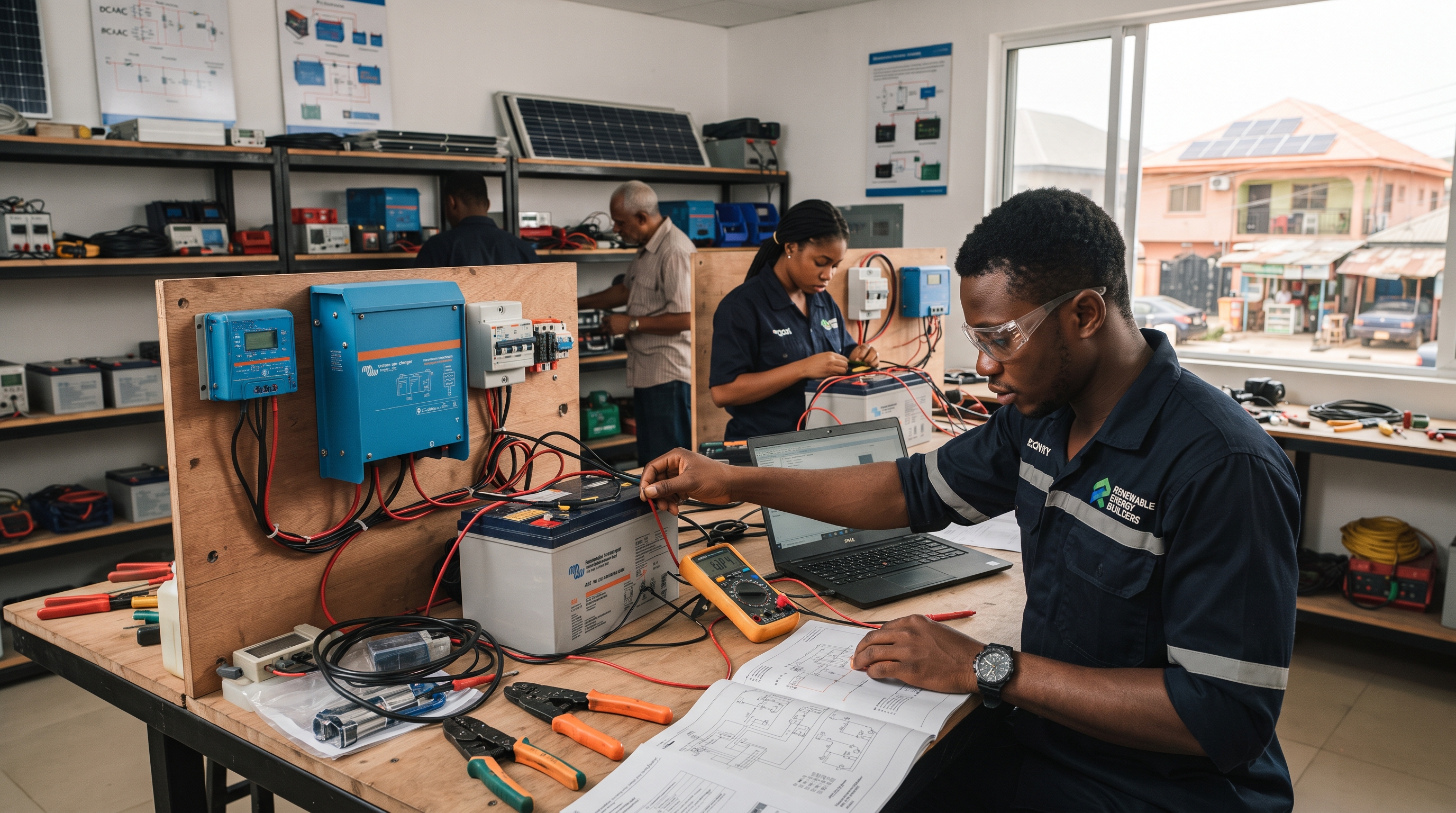
In May 2026, the Federal Government’s own skills gap analysis named solar installation as a field where Nigeria lacks experienced hands, to the point that contractors have been hiring technicians from neighbouring countries. The government has separately assessed that the power sector has only about half the skilled workforce it needs. In July 2026, the Managing Director of the Rural Electrification Agency, Dr Abba Aliyu, noted that Nigeria’s renewable sector has attracted more than 2 billion dollars in investment but supports only around 70,000 to 76,000 jobs, against 16.2 million globally, and argued that every renewable programme should be asked what domestic capacity it actually builds.
Meanwhile the demand pipeline keeps growing. The World Bank supported DARES programme, run by the REA at 750 million dollars, targets 17.5 million Nigerians, over 2.5 million household connections and 1,350 mini grids including 250 interconnected systems. The Global Solar Council recorded 803MW of new Nigerian solar capacity in 2025, taking cumulative capacity to roughly 1.19GW. Local module assembly capacity has moved from about 120MW to around 300MW, with panels now shipping from Lagos to Accra. NERC’s 2026 Mini-Grid Regulations raised the interconnected mini grid ceiling to 10MW and simplified permitting.
Every one of those megawatts needs someone to size it, wire it, commission it and repair it when it fails at 11pm on a Sunday.
The scarcest skill of all is battery pack fabrication. Most Nigerian solar courses teach you to buy a finished lithium battery and connect it. Very few teach you to build one. That single capability, the ability to take Grade A prismatic cells and turn them into a safe, balanced, properly protected 48V pack, is the difference between reselling somebody else’s product on thin margin and manufacturing your own.
Track one: Computer repair and Mobile device diagnostics and repair
This track is about making a living from the hardware that is already in people’s hands. Nigeria remains Africa’s largest smartphone market by population, used devices account for roughly 40 percent of phone sales, and the country generates over 500,000 tonnes of e-waste a year. Every one of those numbers is a repair opportunity.
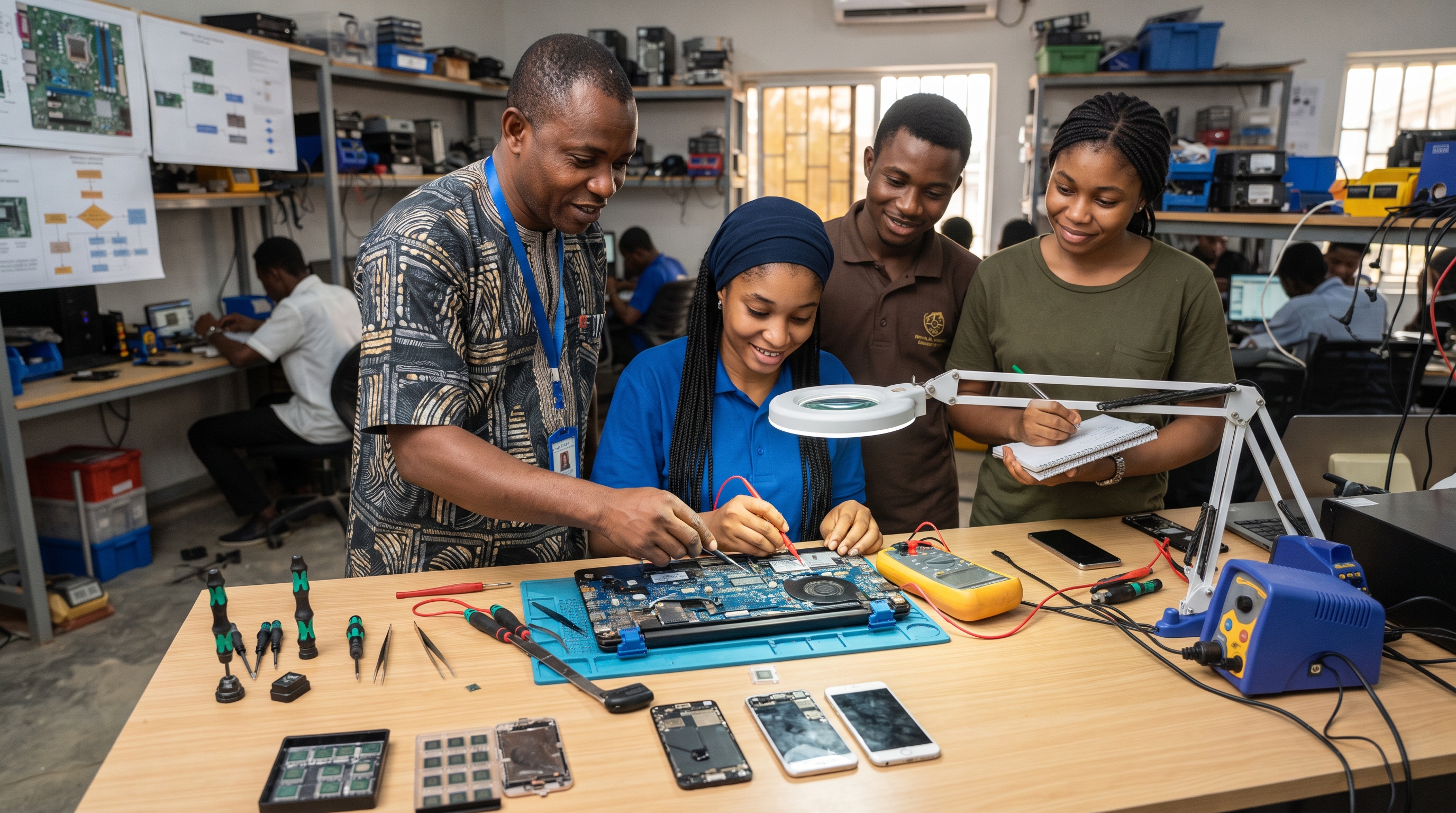
What we teach, and why each piece matters:
Reading a board instead of guessing at it. Trainees learn DC power rail theory, how to read a schematic and a boardview, and how to use a digital multimeter and bench power supply to find a short before touching a soldering iron. A device that draws 0.8A at 4V with no display is telling you something specific. Most technicians never learn to listen.
Power path and charging faults. Failed PMICs, dead charging ICs, corroded Type-C and micro-USB ports, and the tristar or equivalent circuitry that decides whether a phone charges at all. Charging port replacement alone is steady daily income in any Nigerian market.
Micro soldering. Hot air rework, flux discipline, temperature profiles, working with 0201 and 0402 passives, reballing where appropriate, and knowing when a board is genuinely finished. This is the skill that separates a ₦3,000 job from a ₦35,000 job.
Laptop and PC servicing. Display assembly separation and reassembly, keyboard and hinge repair, thermal management, storage cloning, operating system reinstallation, driver and firmware work, and data recovery.
Battery health diagnostics. Cycle count, internal resistance, swelling, and safe handling and disposal of damaged lithium cells. This connects directly to the solar track.
Running the shop. Intake tickets, written diagnostic estimates, warranty terms you can actually honour, handling the customer whose device cannot be saved, pricing your labour, and keeping records. Technical skill without this is a hobby.
Track two: Solar generator building, Lithium pack assembly, and Solar Intallation
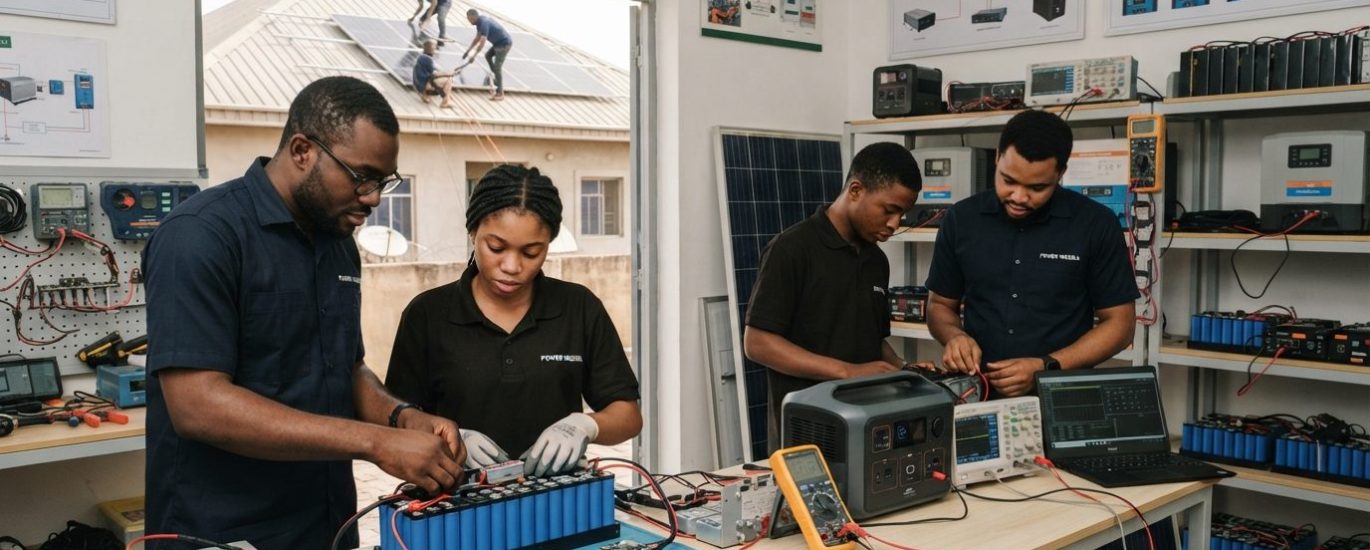
A solar generator is four subsystems working together: photovoltaic generation, charge regulation, energy storage and inversion. We teach the whole chain, then go deep on the part almost nobody teaches.
Why LiFePO4, honestly
Lithium iron phosphate delivers roughly 3,000 to 6,000 cycles at 80 percent depth of discharge, giving eight to fifteen years of realistic service against three to five years for a typical tubular battery. It is also thermally stable in a way NMC chemistry is not, which matters a great deal in a country where a battery cabinet in Ilesa can sit at 38 degrees in March.
It is not free of drawbacks, and we say so in class. LiFePO4 costs far more upfront. It must not be charged below freezing, which is irrelevant here but matters for exported work. Counterfeit and B grade cells sold as Grade A are common in the Nigerian market, which is exactly why cell testing is the first thing we teach and not an afterthought.
The build sequence
- Cell qualification. Every prismatic cell is capacity tested and checked for internal resistance. Cells that will live together in a pack must start together. We work to a voltage variance below 0.02V across the group. Skip this step and one weak cell will throttle the entire pack under load for the next decade.
- Top balancing. Cells are connected in parallel and charged from a regulated DC supply until all of them settle at a uniform 3.65V. This is slow, it is boring, and it is the single most skipped step in Nigerian pack building. It is also why so many locally built packs underperform.
- Series configuration and compression. Cells are arranged in 4S (12.8V), 8S (25.6V) or 16S (51.2V) to match the inverter. Prismatic cells physically swell during cycling, so packs are held in rigid end plates with threaded rods to maintain even pressure. Compression is not cosmetic. It measurably extends cycle life.
- Interconnection. Pure copper busbars or flexible braided straps, sized to a current density above 3A per square millimetre, torqued to manufacturer specification (typically 4 to 6 Nm on M6 studs) with a calibrated torque wrench. Under torque means resistance, heat and a fire. Over torque cracks the terminal seal and ruins the cell. There is no eyeballing this.
- BMS integration. A smart BMS with active balancing and Bluetooth telemetry monitors every cell voltage, pack current and temperature via NTC thermistors, and disconnects on overcharge above 3.65V per cell, over discharge below 2.5V, overcurrent, short circuit or low temperature charging. Balance leads are connected in strict sequence from B- upward. Connect them out of order and you will destroy the BMS in front of the class, which, for the record, is a lesson we have all learned once.
- Protection and commissioning. Inline DC breakers, T class fuses on the main positive, correct earthing and bonding, load testing, and documented commissioning figures handed to the customer.
Component reference
| Subsystem | Specification | Operating parameters | Risk control |
| Prismatic cells | Grade A LiFePO4, 3.2V nominal, 100Ah to 314Ah | 3,000 to 6,000 cycles at 80 percent DoD | Rigid compression frame against swelling |
| Battery management | Smart BMS, active balancing at 50mA or above | 1C continuous discharge, cutoff 2.5V to 3.65V per cell | Sequential balance lead connection from B- |
| Conduction layer | Pure copper busbars, braided straps | Current density above 3A per mm² | Calibrated torque, 4 to 6 Nm on M6 |
| Conversion | Pure sine wave hybrid inverter with MPPT | Efficiency 93 percent or higher, low idle draw | DC breakers and T class fusing |
Alongside the bench work, trainees cover irradiance and shading assessment for South West Nigeria, array sizing against a real load audit, charge controller configuration, roof mounting and safety, earthing, and the paperwork side of quoting a residential or MSME installation.
What this actually pays
We are cautious here, because this is where most training providers oversell.
Published Nigerian industry sources put certified solar technician earnings in the region of ₦150,000 to ₦400,000 monthly, and independent operators who own their customer relationships can exceed that. A device repair technician working a busy market position can realistically build to a similar range within the first year, with earnings weighted toward high value board level jobs rather than screen swaps.
What determines where you land in that range has very little to do with your certificate:
- Whether you actually finished the internship or drifted off after the classroom phase
- Whether you can quote a job accurately and stand behind the quote
- Whether you have working capital for parts, or have to ask every customer for a deposit
- Whether you are in a location with foot traffic and repeat business
- Whether you keep learning after graduation, because inverter firmware and phone architectures change every year
Anyone promising a guaranteed income figure is guessing. What we can commit to is that you will leave able to do the work, with the tools to do it.
Inside the TECH Solar Geeks Program
| Detail | Specification |
| Delivered by | ITECH Vocational Charity (IVC), a registered Nigerian non governmental organisation |
| Format | Six months, dual phase |
| Phase 1 | Three months intensive in person laboratory training at the IVC centre, Ilesa, Osun State |
| Phase 2 | Three months supervised internship with partner solar installers, service centres and maintenance hubs |
| Tracks | Tech Geek Professional (micro-electronics and device servicing) and Solar Geek Professional (PV systems and LiFePO4 fabrication) |
| Base fee | ₦600,000 (sponsorship and scholarship opportunities available) |
| Full scholarships | ₦500,000 sponsored placements for qualifying candidates, funded by institutional partners and donors |
| Included | Free professional repair toolkit: precision drivers, soldering equipment, digital multimeter, wire strippers and consumables |
| Location | IVC Training Centre, Ilesa, Osun State |
| Enquiries | +234 704 257 2451 / itechvocationalcharity@gmail.com |
Two design choices are worth explaining, because they are the reason the program runs six months rather than the six weekends that is common in this market.
The internship is not optional garnish. A trainee who has assembled three battery packs under supervision in a classroom is not yet a technician. A trainee who has spent three months on real installations, dealing with a customer whose system tripped at midnight and a roof that is not the shape the drawing said it was, is. This mirrors the approach taken by the UNDP’s own six month solar training programme in Nigeria, which graduated 200 technicians with toolkits and registered business names attached.
The toolkit goes out on day one, not graduation day. Tools you have used for six months are tools you can work with. Tools handed over at a ceremony are tools you sell in January.
Who this program is not for
Trust means saying this part out loud.
This is not a good fit if you are looking for a certificate to hang on a wall rather than a trade to practise. It is not a fit if you cannot commit to being physically present in Ilesa for three months. It is not a fit if fine motor work under a microscope frustrates you, or if working with high current DC systems, where a dropped spanner across a busbar is a genuine hazard, makes you uncomfortable rather than careful.
It is a strong fit if you are a secondary school leaver or graduate who is practical minded, if you already tinker with electronics informally and want to do it properly, if you intend to run your own workshop, or if you are an existing repair or electrical artisan who wants to add lithium and solar competence to what you already do.
Frequently asked questions
Do I need a science background or a degree?
No. You need literacy, numeracy and steady hands. We start from DC theory. Trainees have come from arts backgrounds and outperformed engineering graduates.
Is the fee payable at once?
Contact the team on the numbers above to discuss payment structure and to confirm current scholarship availability, which is limited and allocated by need and assessment.
What certification do I receive?
An IVC completion certificate covering both tracks, plus a documented internship record. We will be direct: in this trade, your portfolio of completed jobs and your customer references will earn you more work than any certificate. Build both.
How much capital do I need to start working after graduation?
The toolkit covers your bench. Realistically you should plan for working capital for parts and consumables, plus a workspace, even if that workspace is a shared table in an existing shop for the first six months. Many graduates begin by sub contracting board level work from shops that cannot do it themselves.
Is solar always cheaper than a generator?
No. For very low daily energy use, or where someone already owns a working generator and runs it two hours a day, the payback period can stretch past five years. An honest technician runs the numbers for the customer and sometimes advises against the sale. We teach that too, because a reputation for honest sizing is the most valuable asset a small installer has.
Apply
The TECH Solar Geeks Program runs from the IVC Training Centre in Ilesa, Osun State, in a six month dual phase cycle, with three months of in person laboratory work followed by a three month supervised industry internship.
Apply here: Registration Form
To ask about the next intake, scholarship eligibility or partnership opportunities:
Phone / WhatsApp: +234 704 257 2451
Email: itechvocationalcharity@gmail.com
Location: IVC Training Centre, Ilesa, Osun State, Nigeria
Employers, solar installation companies and maintenance hubs in Osun, Ondo, Oyo and Ogun who would like to host interns are welcome to get in touch on the same channels.
Sources and further reading
- National Bureau of Statistics, Nigeria Labour Force Survey, Q2 2024
- Foundation for Investigative Journalism, reporting on the absence of published labour statistics since Q2 2024, January 2026
- World Bank, technical notes on Nigeria’s power sector and the DARES project appraisal ● Rural Electrification Agency, DARES programme targets and 2026 statements by Dr Abba Aliyu
- Nigerian Electricity Regulatory Commission, Mini-Grid Regulations 2026 ● Federal Ministry of Education, national skills gap analysis remarks, May 2026
- Global Solar Council, Nigeria installed capacity data for 2025
- Osun State Electricity Market Regulatory Law 2025 and Osun State Ministry of Energy announcements
- United Nations Development Programme Nigeria, Renewable Solar Energy Systems training cohort
- Nigerian downstream pricing reporting, NNPC, Dangote Refinery and depot price coverage, July and August 2026
- Published Nigerian installer price lists for hybrid solar and LiFePO4 systems, 2026
Author
Itech Vocational Charity Team
About ITECH Vocational Charity (IVC) IVC is a registered Nigerian non governmental organisation working to expand practical IT and clean energy skills, reduce youth underemployment and support the transition to reliable off grid power across the South West and beyond.